

From “Young and Dumb” to a Machine in Control
The Complete Pogačar Series · Six Parts in One
The Pogačar System – PART 1
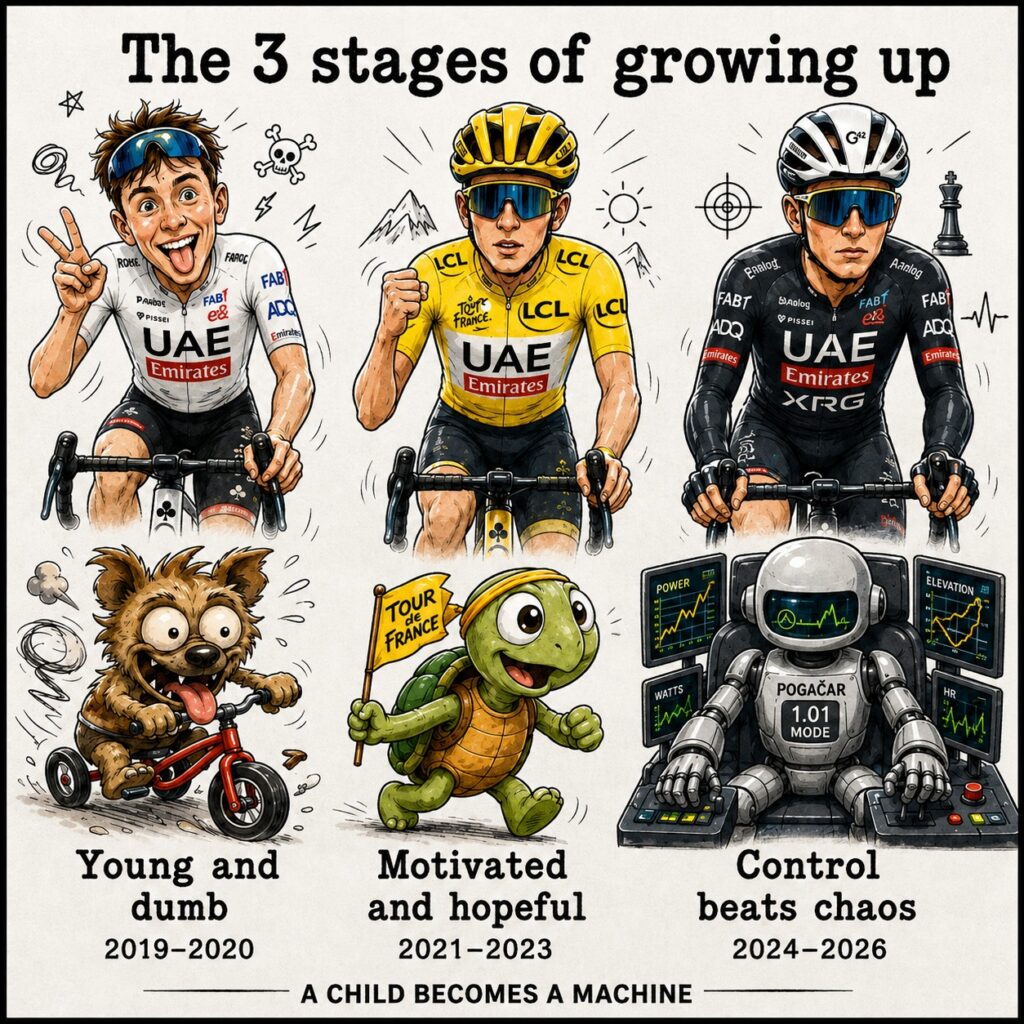
From “Young and Dumb” to total control: the rider, the super-team, durability, altitude and marginal gains, the modern bike — and the rules of a sport struggling to keep up.
Six Articles, One Picture
Everyone wants a headline. I will try to explain. Briefly? Absolutely not. If you want thirty seconds, there is always Instagram.
Pogačar’s victories and UAE’s dominance did not appear by accident, and they were not created during two weeks of the Tour. They emerged from the development of the rider, the construction of the team, training quality, durability, altitude and heat, fuelling, equipment, aerodynamics, money, grey areas and regulation. Looking at one attack, one climb or one power estimate at a time misses the system.
This is the full argument in one continuous article: six layers that interact. No single layer explains everything. Together, they explain far more than the usual television debate.
From “Young and Dumb” to a Machine in Control

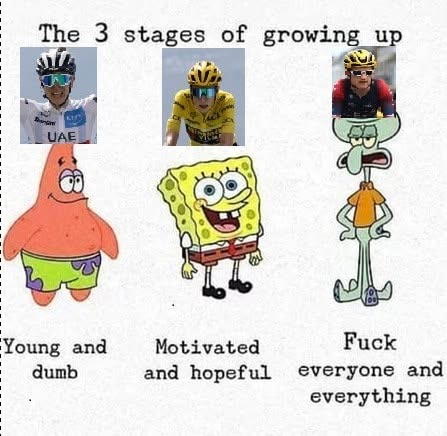
The evolution of Tadej Pogačar from 2019 to 2026.
2019: The Talent Who Did Not Yet Know He Was Supposed to Be Afraid
Pogačar joined UAE at 20, in his first WorldTour season, after winning the Tour de l’Avenir. He was not signed as the team’s established Grand Tour leader. Within months it was obvious that he was not behaving like a young rider asking permission to learn from the stars. He raced as though he already belonged among them.
At the Vuelta a España he won three stages, finished third overall and took the white jersey. His recovery between days, time-trial ability, punch and complete lack of deference were already visible. He was not yet a rider who controlled a Grand Tour. He was a rider capable of detonating one.
2020: Tour Champion Before He Learned How to Manage a Tour

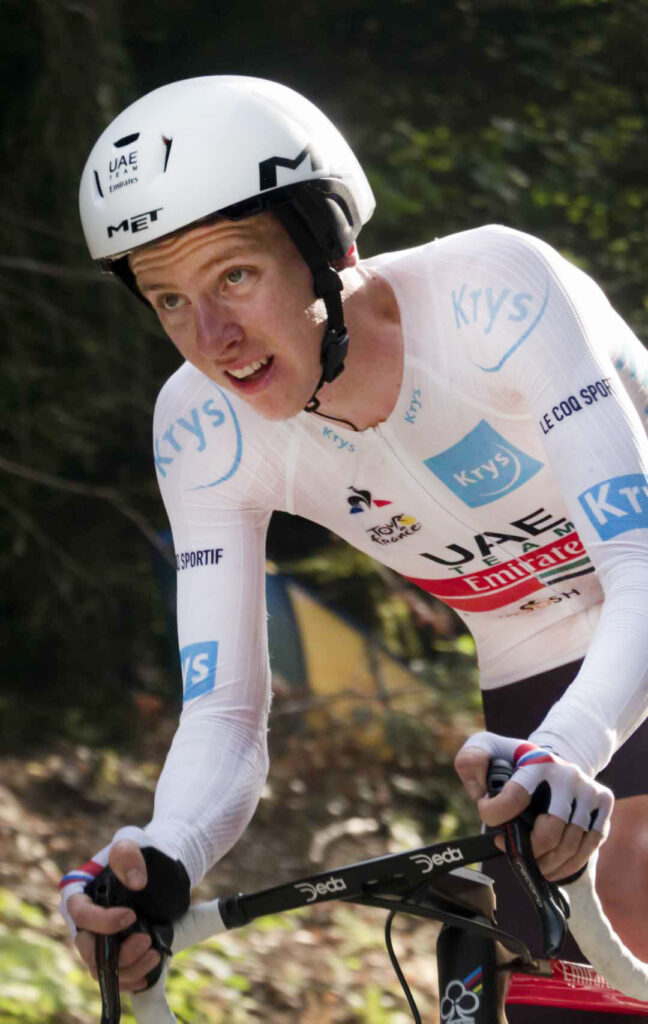
His first Tour victory was largely an individual victory. UAE was not yet a mountain armada, while Jumbo–Visma controlled the race around Primož Roglič. Pogačar remained close, absorbed the pressure, and overturned the race in the time trial to La Planche des Belles Filles.
The performance was historic, but the model was still simple: stay within range, survive, then produce one maximal intervention. He knew how to win a Tour. He did not yet know how to control all three weeks.
2021: Absolute Power — and the Danger of Absolute Confidence
In 2021 he arrived as the favourite and won by a large margin. He could time trial, climb, race in cold and rain, and still dominate when the entire peloton prepared specifically for him. But seasons like that create a trap. When you repeatedly discover that you can close every move and attack again, you begin to believe that every response is free.
He was no longer merely confident. He became too confident that strength could solve every tactical problem. That assumption would break a year later.
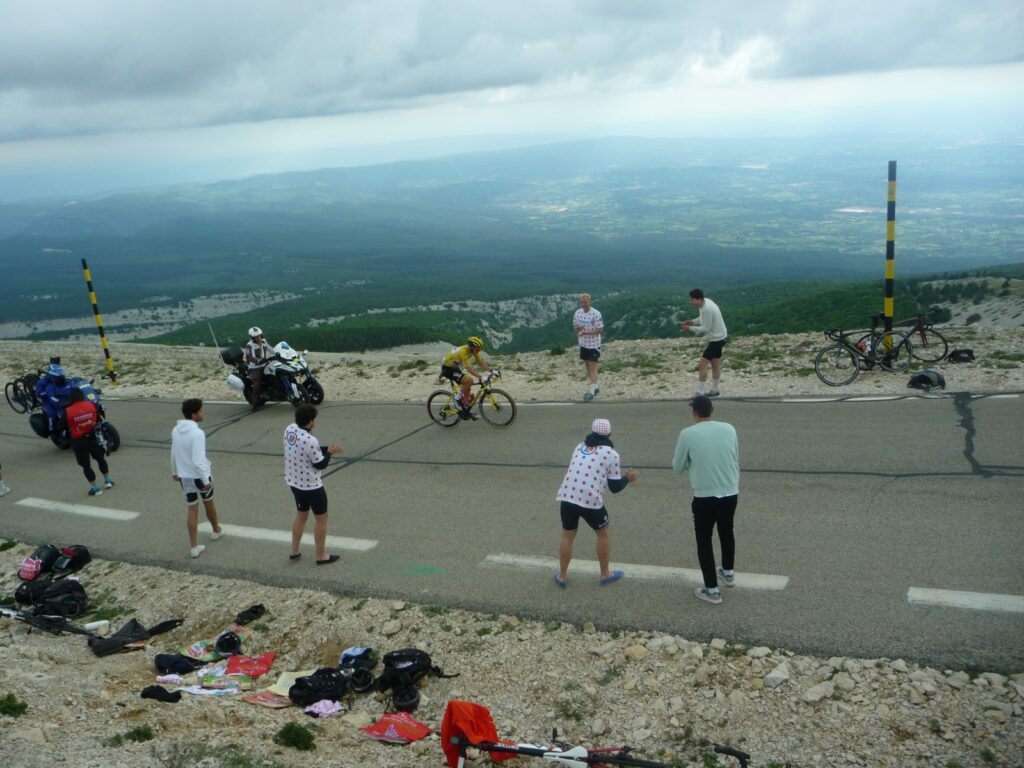
Anthospace, Wikimedia Commons, CC BY-SA 4.0.
2022: Jumbo Taught Him That You Cannot Beat Everyone, Everywhere
Pogačar arrived as a double Tour winner and rode as though there was no reason to change. This time Jumbo–Visma brought two general-classification threats — Vingegaard and Roglič — and a much stronger supporting system.
First error: too many efforts that did not need to be made
Not every stage victory and every handful of seconds is worth its metabolic cost. The younger Pogačar often operated on a seductive logic: if I can win today, why should I not? The mature rider asks what today’s win will cost and what tomorrow will demand.
Second error: the Granon trap
On Stage 11, Roglič was already the lesser GC threat. Vingegaard was the principal danger. Yet Pogačar answered both, closed move after move and even counterattacked. Jumbo made him treat two riders as if both were about to win the Tour.
On the Col du Granon, Vingegaard attacked and Pogačar broke. The team tactics created the conditions, Pogačar spent energy inside the trap, and Vingegaard was also stronger in the decisive effort.
Race behaviour sits between courage, fear, wisdom and stupidity. None is always good or bad; dosage matters. Excessive courage can become stupidity. Excessive caution can become fear. Efficiency lives in the balance.
2023: This Time Tactics Could Not Carry All the Blame
UAE arrived stronger and Adam Yates finished third, but Pogačar’s preparation had been disrupted by a fractured wrist. The Tour remained close for two weeks, then came two decisive days. Vingegaard’s time trial to Combloux opened a huge gap. The next day, on the Col de la Loze, Pogačar collapsed after an enormous mountain stage.
This was no longer just a story about the team or a tactical mistake. Vingegaard was superior in the specific quality that decides Grand Tours: producing elite power after extreme accumulated load. To win again, Pogačar did not merely need to race more intelligently. He needed to change what remained after four and five hours.
2024: Not More Pogačar — a New Pogačar
The great change was not necessarily a spectacular jump in FTP. It was a reduction in the difference between fresh Pogačar and fatigued Pogačar. Work with Javier Sola and UAE’s performance structure emphasised strength, high-quality endurance, VO₂max and durability: the capacity to preserve performance after load.
At the Giro he dominated, but also managed: when to attack, when to allow a break to go and when to win without emptying the tank. At the Tour he presented the opposite of Granon 2022. He let the opponent work, waited, and then made one move at the correct time.
2025–2026: Managing Success, Motivation and Leadership
A new problem appeared: not how to win, but how to avoid being consumed by the obligation to win everything. Pogačar and UAE became more selective, removed some non-essential racing and protected motivation as carefully as the legs.
His leadership also developed. He was no longer simply the star for whom everyone worked, but a rider capable of changing objectives inside a stage, protecting a teammate and thinking about the system’s success. By 2026, the most important difference was not simply the number of yellow jerseys. He had become a better manager of his own power and the power around him.
| Area | Younger Pogačar | Mature Pogačar |
|---|---|---|
| Pacing | Closes and attacks at almost every opportunity | Classifies threats and chooses the moment |
| Fatigue | Enormous punch when fresh | Punch preserved after hours |
| Team | Sometimes wins despite limited depth | Uses and directs an armada |
| Season | Wants to race and win almost everything | Selects objectives and protects recovery |
| Mentality | Proves superiority in every exchange | Also possesses the power not to respond |
Pogačar in 2019 could do things others could not. In 2021 he did them harder. In 2022 he thought he could do them all the time and paid for it. In 2023 he met the limit of durability. From 2024 onward he built a system of control around the wild talent.
From Big Money to a Winning Machine – part2
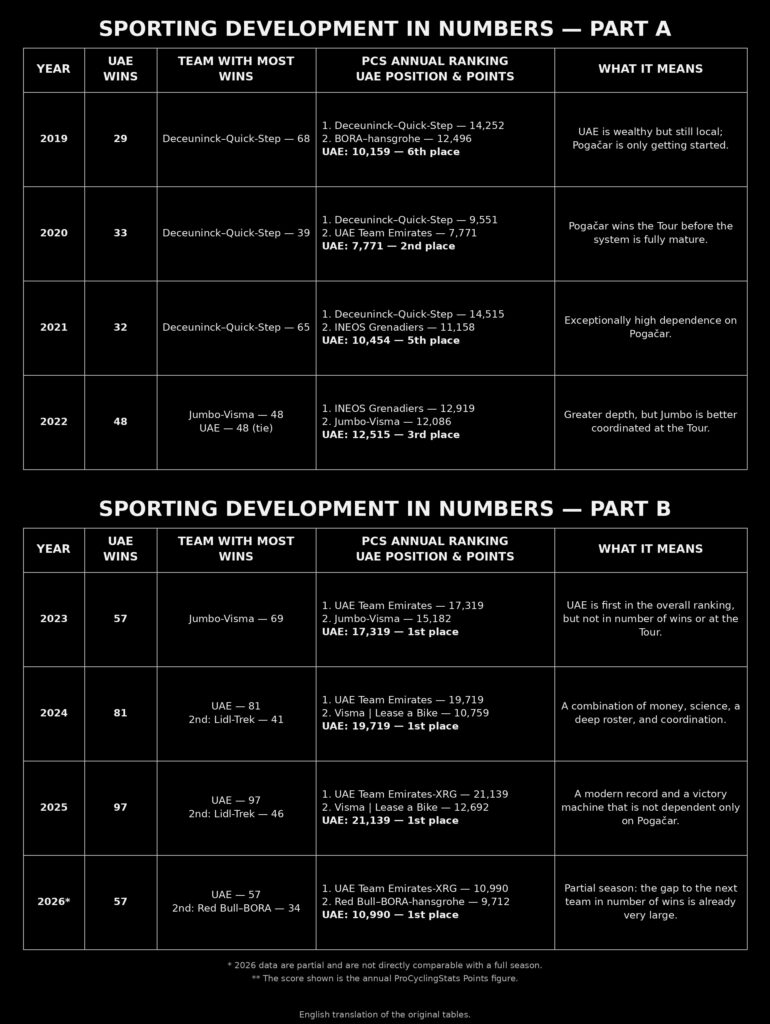
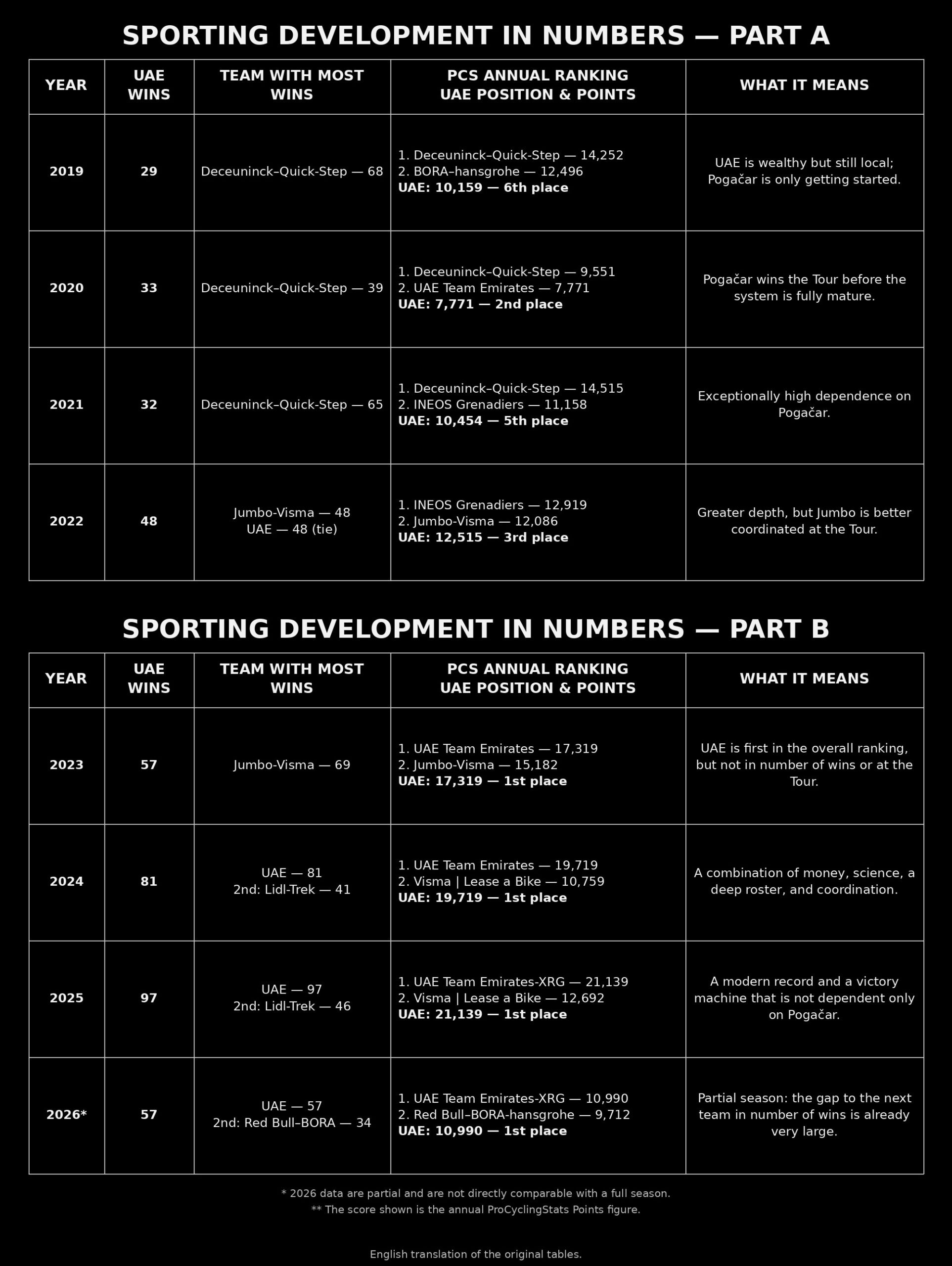
How UAE was built around Pogačar and evolved from a wealthy but scattered team into a superpower — from 29 victories in 2019 to 97 in 2025.
UAE’s evolution moved alongside Pogačar’s: from a rich but dispersed team in 2019 to a deep, coordinated and dominant system in 2024–2026. The win count matters, but money alone is not the explanation. The transformation happened when budget met management, performance culture, rider development and tactical coordination.
Budget warning: professional cycling teams do not publish complete audited salary and budget accounts. Media figures are estimates assembled from partial documents and industry reporting. Treat ranges as estimates, not audited fact.
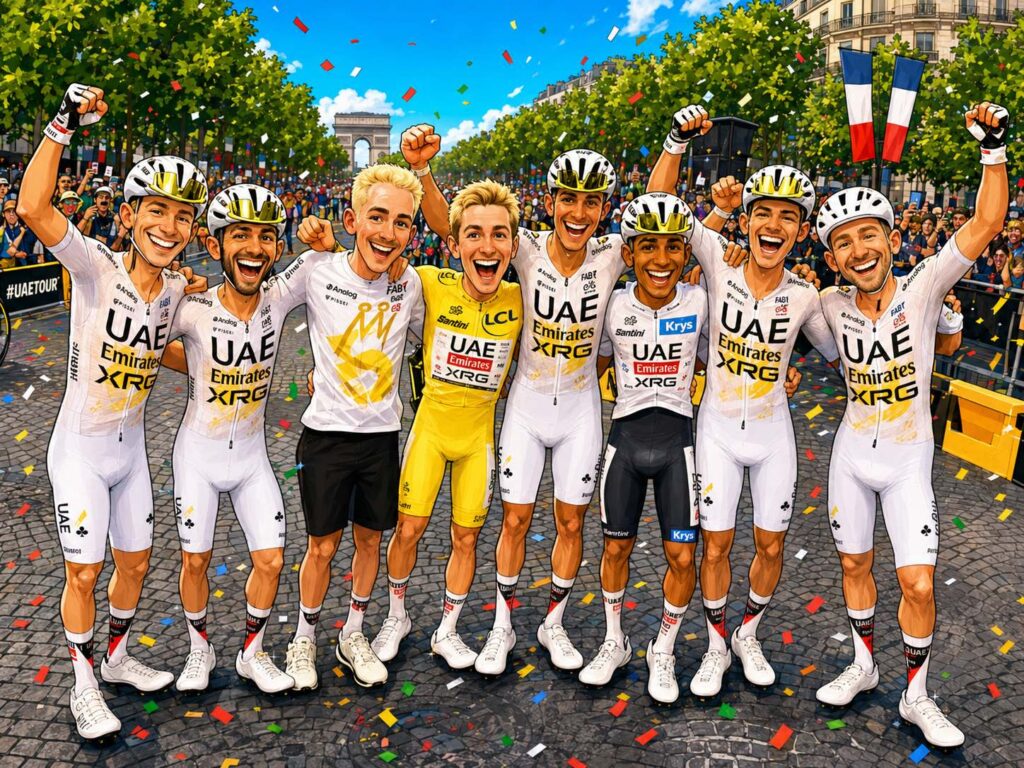
2019: Money and Stars, but Not Yet a System
UAE was already established and well funded, with riders such as Alexander Kristoff, Fernando Gaviria, Diego Ulissi, Rui Costa, Dan Martin and Fabio Aru. It was not a small team. Its ambitions, however, were scattered across sprints, classics, stages and GC without one clear centre of gravity.
Money can purchase riders. It cannot guarantee one method, individual improvement or common timing. Pogačar arrived precisely as the organisation began converting a large budget into a performance system.
2020–2021: The Star Runs Ahead of the System
Pogačar’s 2020 Tour victory changed the team’s model. Once UAE discovered that it possessed a rider capable of winning the world’s most important race at 21, it made sense to build contracts, staff, recruitment and a multi-year programme around him.
Yet he remained far better than the team’s GC depth. In those early seasons, he produced a huge share of its victories and ranking points.
2022: Buying Depth Is Not the Same as Operational Strength
João Almeida, Marc Soler, George Bennett, Brandon McNulty, Marc Hirschi, Rafał Majka and Juan Ayuso made the roster far richer. Several could have led other teams. The number of wins rose, but the Tour showed that an inventory of talent is not necessarily a tactical unit.
Jumbo–Visma knew how to deploy Roglič, Vingegaard, Sepp Kuss and Wout van Aert towards one objective. UAE was strong, but less coordinated in the decisive race. Granon was a lesson for both rider and management: it is not enough to employ strong cyclists. You must place, protect and activate them at the right moment.
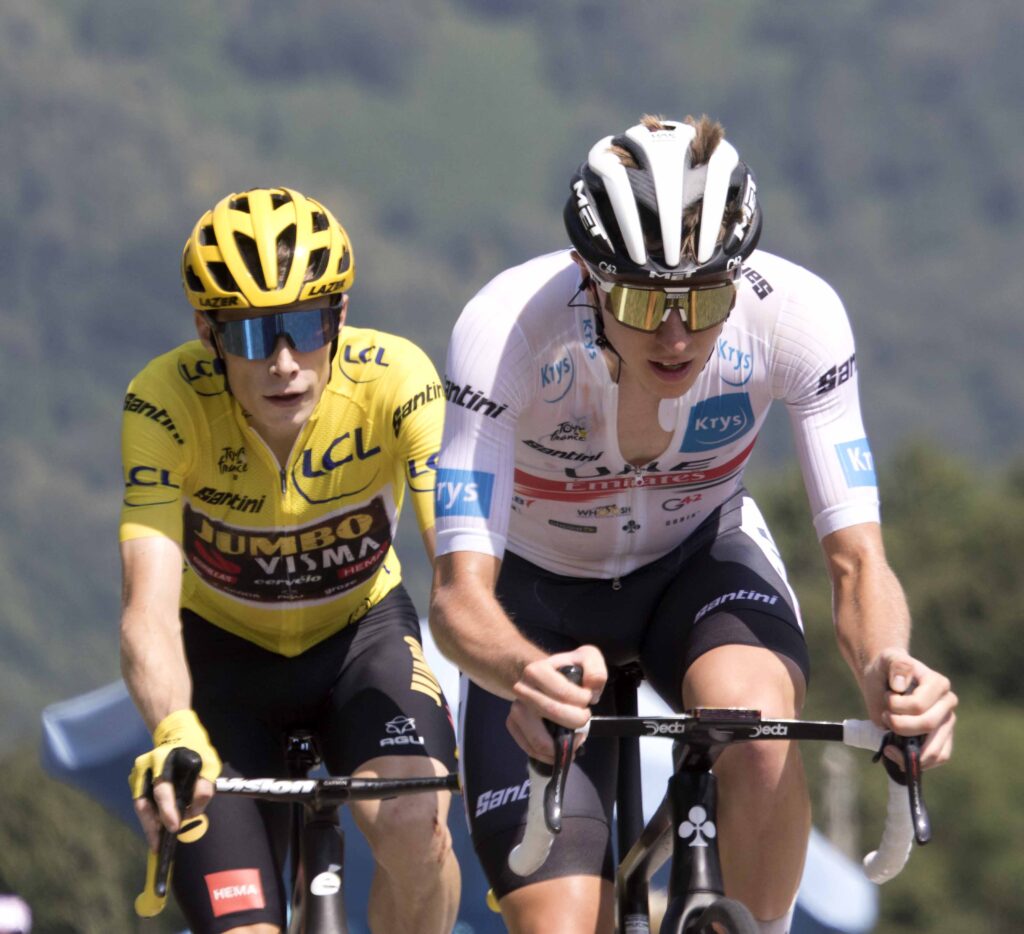
: filip bossuyt, Wikimedia Commons, CC BY 2.0.
2023: World Number One Before Winning the Tour Again
The arrival of Adam Yates and Tim Wellens marked a new phase. Yates was not a conventional mountain domestique; he was a stage-race winner and Tour podium rider. UAE reached 57 victories and ranked first in the world.
Pogačar’s relative share of the team’s points fell, not because he weakened, but because the environment strengthened. UAE could now be the best team in the world when Pogačar was not present. Vingegaard still beat him at the Tour, however, so the system had not yet solved its primary task.
2024: The Armada
In 2024 the budget, science and roster connected. Almeida, Yates, Ayuso, Pavel Sivakov, Soler, Wellens and Nils Politt gave Pogačar control on the flat, in crosswinds, through breakaways and in the mountains. Several were capable of leading a Grand Tour elsewhere.
Published industry estimates placed the budget in the region of €55–60 million, with especially high rider-salary expenditure. The figures were not official, but they illustrated how one team could simultaneously employ the world’s best rider, multiple leaders, classics specialists, a large scientific staff and elite training camps.
The result was 81 victories distributed widely across the roster. Remove Pogačar’s results and a team still remained that could compete for number one in the world.
2025–2026: A Factory for Winners
UAE reached 97 victories in 2025. Pogačar continued to win at extraordinary volume, yet his share of team victories declined. Isaac del Toro, Almeida, McNulty, Jhonatan Narváez, Yates, Jay Vine, Jan Christen and António Morgado produced results in parallel.
This was no longer a hierarchy of one star and seven servants. It was a system with several centres of power, with Pogačar as the most important centre but not the sole source of wins and points.
What Actually Changed Inside the System?
Pogačar’s long contract allowed years of roster, staff, calendar and sponsorship planning around a stable anchor.
Yates, Almeida, Ayuso, Sivakov and McNulty are not ordinary domestiques. Their presence protects Pogačar, applies early pressure and keeps UAE winning elsewhere.
Politt for wind and flat terrain, Wellens for classics and control, climbers for long mountains, and young riders in races where they can develop as leaders.
The team can place a rider up the road, force rivals to work, preserve a second GC option and choose when Pogačar truly needs to intervene.
While Pogačar prepares for the Tour, other riders win stage races, one-day races and week-long events.
A podium-level rider can function as domestique, alternative leader or tactical threat, depending on the race.
Depth also creates internal tension. Riders capable of leading elsewhere must sometimes sacrifice personal goals. The stronger the roster, the more management of ego, contracts and calendars becomes part of performance itself.
Pogačar’s Salary as a Symbol
His exact salary is private, but media estimates rose from several million euros early in his Tour-winning period to more than €8 million in later years, before bonuses and sponsorship. The contract through 2030 is more than compensation. It is a strategic asset around which UAE can plan recruitment, staff, sponsors and budget.
Did UAE Buy Its Dominance?
Yes, partly. Money permits multiple leaders, elite substitutes, a large scientific structure and simultaneous campaigns.
But not only. UAE was wealthy when it was less coordinated and less efficient. Money buys the components; it does not assemble them into a system.
Legal Science, Durability and the Principles of Training – Part 3
The work commentators rarely discuss because it happens months before the television pictures.
When Pogačar and UAE dominate, the broadcast speaks about talent, money and roster depth. All are relevant. Much of the advantage, however, is built in season planning, strength rooms, load management, fuelling, sleep and the decision not to train on the day when more training would only create more fatigue.
Less Meaningless Volume, More Work with a Job
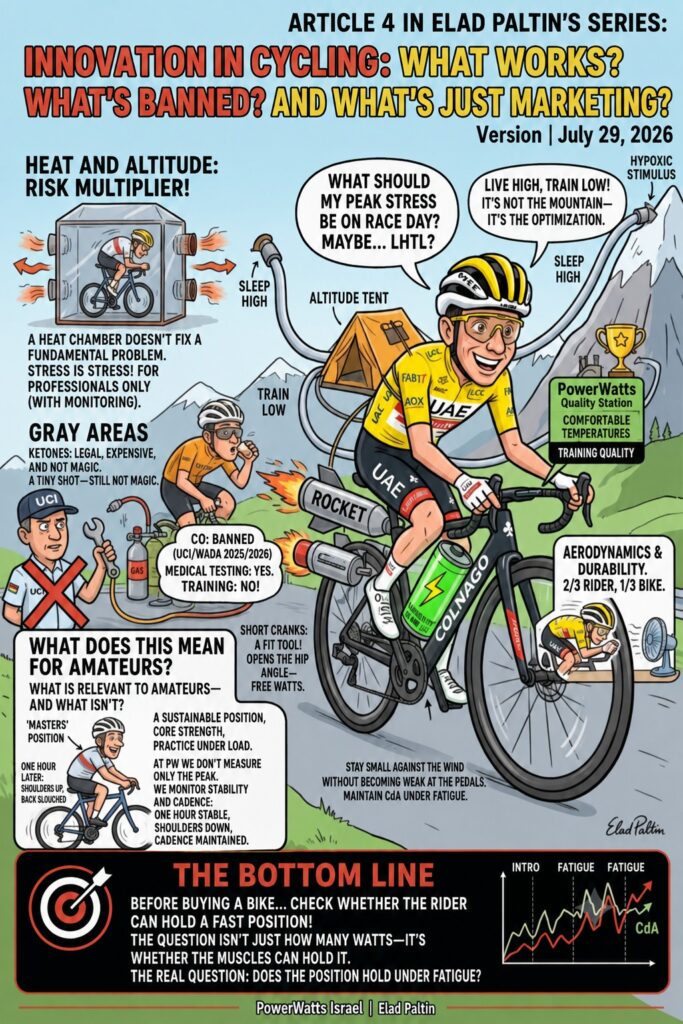
One important shift in UAE’s performance approach from the end of 2018 was tighter load monitoring and less unnecessary work. Many professionals do not train too little. They sometimes perform too many hours, too much riding without a specific purpose and too little recovery.
This does not turn professionals into amateurs. Eighteen to twenty-two hours a week remains enormous. The distinction is fewer kilometres accumulated because tradition says they should be accumulated, and more sessions with an explicit purpose:
Aerobic work with a defined objective, not kilometres for their own sake.
Gym work, stability, force transfer and on-bike mechanical loading.
Low- and high-cadence work selected for the session’s objective.
Intervals and significant efforts after accumulated load.
The formula is neither low volume plus endless intensity nor a rigid 80/20 slogan. It is less meaningless work and more precise work, adjusted to what the rider can absorb. Volume helps only when the body can convert it into adaptation. When volume grows faster than sleep, nutrition and recovery, it stops being stimulus and becomes accumulated fatigue.
Durability: Not How Much Power You Have, but How Much Remains
VO₂max, FTP, CP20 and watts per kilogram matter, but they mainly describe the fresh rider. The Tour is decided after hours of riding, climbing, changes of pace, heat, thousands of kilojoules and weeks of accumulated load.
Durability is the preservation of performance under fatigue. The question is not only your five-minute power. It is your five-minute power after four hard hours.
Two riders with the same laboratory FTP may be entirely different in hour five. One preserves power, cadence and technique. The other begins to fade, raises the shoulders, opens the elbows, responds late and pays more energy for every action.
Endurance — or Merely the Ability to Survive?
Many endurance athletes believe they are developing endurance when they are mainly rehearsing how not to stop: more hours, more distance and more fatigue, without measuring what remains at the end.
Finishing a distance has value, but finishing alone does not prove that the session was productive. Competitive road endurance is the ability to keep performing after fatigue already exists:
- Preserve power.
- Maintain cadence.
- Retain technique and breathing control.
- Respond to changes of pace.
- Remain capable of one meaningful action near the finish.
A fresh 20-minute test is a still photograph. A complete workout or race is the film. Perform the same test after three demanding hours and the difference between attractive laboratory numbers and real durability becomes visible.
The Difference Appears on the Final Climb
Some riders look strong for hours, then begin to pedal “in squares”: lower cadence, high torque, heavy movement, less stable pelvis and shoulders working almost as hard as the legs. Truly durable riders can still choose a lighter, faster rhythm.
This does not mean high cadence is always superior or that every rider should climb at the same rpm. It means the durable rider still owns a choice. Fatigue has not forced one heavy gear and one slow movement upon him.
High cadence under load requires neuromuscular coordination, movement efficiency, pelvic stability, controlled breathing and the ability to repeat force without turning every revolution into a fight. When that ability disappears, the rider may still produce watts, but every watt becomes more expensive.
Strength, Torque and Cadence
Strength training, body control, on-bike torque work and selected low-cadence/high-power efforts are not designed to create bodybuilding mass. They improve force transfer, stability and the preservation of efficiency as fatigue accumulates.
Low-cadence work develops torque and stability. High cadence demands coordination, neural control and smooth movement. A complete professional is not trapped at one rpm. He can move between ranges without dismantling technique as gradient, speed, wind, gearing and fatigue change.
What Does This Mean for the Amateur?
An amateur should not copy Pogačar’s volume. The amateur does not possess his time, sleep, nutrition or recovery staff. The useful question is not how many hours were accumulated this week, but how much of that load became improvement.
PowerWatts does not examine only the highest peak. It asks whether the effort was repeatable, cadence remained stable, execution remained accurate, deterioration appeared, pedalling stopped during recovery, and quality still existed at the end.
A rider who opens the first interval with a spectacular number and then disintegrates is not necessarily stronger than the rider who begins slightly lower and remains precise. For a time-limited amateur, 75 structured minutes can be worth more than three undefined hours — not because volume is unimportant, but because volume that cannot be absorbed is often fatigue dressed as training.
When Motivation Starts Working Against You
There is a point at which a hard session stops producing improvement and only adds fatigue. Cadence falls, movement becomes heavy, perceived effort rises at the same power, technique degrades, recovery between efforts weakens and the next day’s performance suffers.
The problem is not one hard session. It is a rapid rise in load combined with insufficient sleep, incomplete fuelling and inadequate recovery. Professional systems are designed to detect the trend and reduce load. Motivated amateurs often add another session at exactly the moment when less is required.
Fuelling and Recovery Are Performance Units
A rider who repeatedly under-fuels is not developing durability; he is repeatedly training depleted. The capacity to consume and absorb carbohydrate over hours helps the rider reach the final climb with more glycogen, better concentration and a greater ability to return above threshold. Leading teams train the gut and adjust fuelling to route, weather, power and tactics.
Recovery is not merely a day off. Training creates the stimulus; sleep, nutrition, treatment and reduced load are when the body attempts to convert it into improvement.
Measuring Durability without a Laboratory
- Compare power or NP in the first and final sections.
- Track cadence deterioration in identical tasks.
- Count complete stops or failure to pedal during recovery.
- Observe technique and posture under fatigue.
- Measure TIZ and target accuracy.
- Evaluate repeatability, not only the single peak.
- Ask whether pace can rise again near the end.
- Include the following day’s recovery.
The highest number that appeared for one instant is not always the most informative. The questions are whether it can be repeated, at what cost, and what happens after another hour of work.
Altitude, Heat, Grey Areas, Biomechanics and Aerodynamics – Part 4
What actually works, what is dangerous, and what has any relevance to an amateur.
Altitude Camps: The Mountain Does Not Make You Fast
The simple story says: go high, detect low oxygen, produce more red blood cells, return stronger. Reality is less cooperative. Altitude response varies greatly between riders and even within the same rider from one camp to another. Iron status, sleep, nutrition, hydration, energy availability, health, training load, exposure duration, sleeping altitude and the timing of return to competition all matter.
Some riders respond well. Others mainly return tired. The advantage of UAE and Visma is not merely the money to visit Teide or Sierra Nevada. The mountain is available to many. Optimisation is not.
Personal history, iron, sleep and haematological response.
Enough hypoxic dose to stimulate without dismantling the rider.
Easy work high; preserve mechanical quality for key intensity.
Recovery and sharpening timed to the target race.
Live High, Train Low — and Peak at the Correct Time
The classic model separates hypoxic exposure from the mechanical quality of training: sleep and spend time high, perform controlled endurance there, and move lower for sessions that require maximal power, speed and quality. Hard work at altitude can feel physiologically severe while producing less power and a weaker muscular stimulus than intended.
This is not an absolute law, and study results vary, but the principle is useful: obtain the altitude stimulus without surrendering the quality of work that requires high output.
Timing is equally important. A camp creates load. Sleep may initially deteriorate and perceived effort may rise. Adaptation does not appear magically on the drive down the mountain. The team must plan when to descend, how long to recover, when to restore intensity and how to arrive at the target race neither fatigued from the camp nor too late to benefit from it.
The secret is not only to create adaptation. It is to make the adaptation arrive on the correct day.
Altitude and Heat: Force Multiplier or Risk Multiplier?
Altitude and heat create different adaptations. Altitude provides a hypoxic stimulus and may affect the haematological system. Heat can expand plasma volume and improve thermoregulation. On paper, the combination sounds ideal. In practice, both are major stressors.
Altitude reduces oxygen availability. Heat raises cardiovascular strain, core temperature, sweating and dehydration risk. Add hard training, travel, poor sleep and low energy availability, and a sophisticated stimulus can quickly become fatigue the body cannot convert into adaptation.
Evidence does not show an automatic bonus from combining heat and altitude beyond either method alone. The combination must therefore be gradual, individual and closely monitored. More stimuli do not necessarily create more adaptation. Sometimes they create only more fatigue.
The Grey Areas
Exogenous ketones: legal, expensive and not reliably magical
Ketone supplements are promoted as an additional fuel and possible aid to recovery. Research is inconsistent: some studies show small benefits in specific conditions, others no improvement, and some report gastrointestinal discomfort or worse performance. They may be a niche tool in an elite system where fractions matter. They are not a convincing central explanation for dominance.
Carbon monoxide: a measurement tool that became a disturbing story
Carbon monoxide is toxic. In tiny, controlled medical doses it has been used as a tracer to estimate total haemoglobin mass and blood volume. The controversy concerned repeated inhalation outside a diagnostic purpose. The UCI prohibited repeated inhalation from 10 February 2025, while tightly controlled medical measurement remained possible under professional responsibility.
Xenon: a dramatic shortcut with weak evidence
A 2025 Everest story proposed that xenon exposure accelerated acclimatisation by influencing hypoxia-related pathways. The climbers had also trained with simulated-altitude systems and used supplemental oxygen, making it impossible to attribute the achievement to xenon. Strong evidence that xenon can replace gradual acclimatisation or reliably protect against extreme-altitude illness does not exist. Xenon is also prohibited by WADA as a HIF-pathway activator.
The deeper risk is false confidence: a dramatic intervention can persuade somebody to move faster into an environment where physiology has not actually caught up.
Back to the Legal Zone: the Short-Crank Revolution
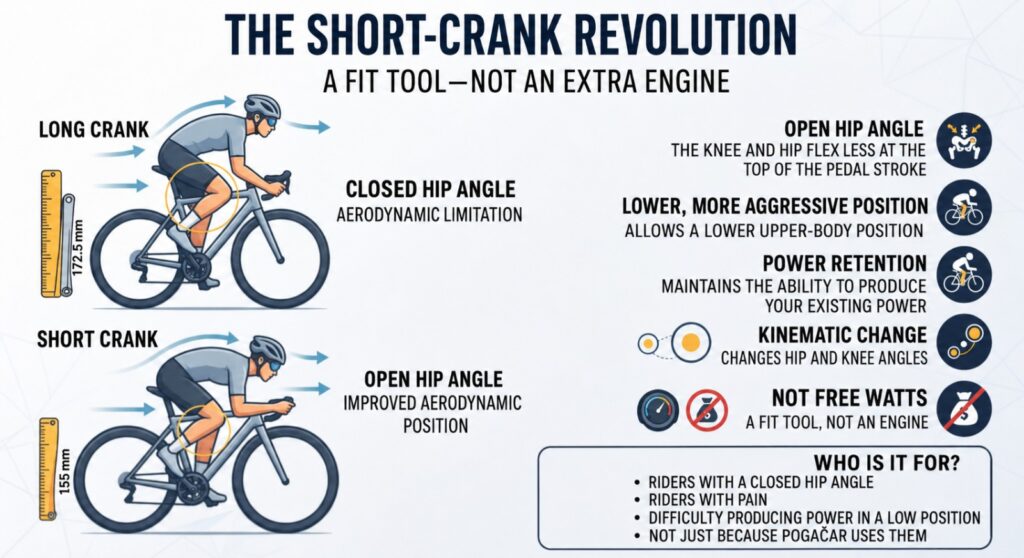
For years, 172.5 mm was treated almost as a road default. Elite riders now use 165, 160, 155 and occasionally 150 mm, especially in time trials and aggressive road positions. A shorter crank does not create free watts.
A smaller radius reduces hip and knee flexion at the top of the stroke. This may open the hip angle, permit the saddle to move forward and allow a lower torso without excessively closing the body. The likely advantage is not higher power in isolation, but the ability to preserve existing power in a more aerodynamic position.
Moderate changes in crank length do not necessarily alter efficiency or maximal output in trained riders, but they do change joint angles and pedalling kinematics. Selection should answer a fit problem, not copy Pogačar.
Moving the Cleat Rearwards: Stability, Not Automatic Power
A rearward cleat shortens the lever around the ankle, may reduce demand on the calf and Achilles tendon, and can create a more stable platform for long riding or time-trial positions. It may help riders with calf loading, foot instability or difficulty holding a position.
It does not automatically create watts. Moving too far can alter saddle-height requirements, change standing feel and affect sprinting. Crank length, cleat position, saddle position and handlebar drop must be treated as one system, preferably through competent bike fitting.
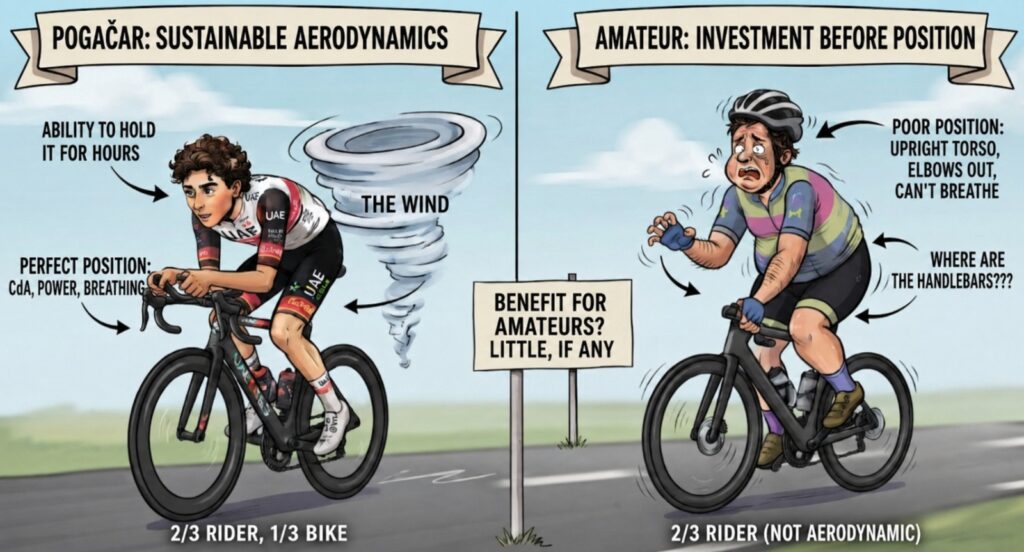
Aerodynamics: The Fastest Position Is the One You Can Hold
A wind-tunnel number is not a racing position if the rider cannot breathe, see the road, pedal efficiently or remain stable in it. Aerodynamic drag is determined by the rider–bike system, and the rider is the largest component.
The correct question is not “How low can I go for a photograph?” It is “How low can I remain while producing power and controlling the bike after fatigue?”
The Muppets’ Balcony versus 2026 Physiology
Veteran riders and commentators understand cycling deeply, but the environment in which they learned the sport was different. Earlier eras generally involved fewer and less precisely controlled altitude exposures, lower carbohydrate intake during racing, less continuous load monitoring, less individualised recovery, longer cranks, narrower tyres, higher pressures and less integrated aerodynamics.
That does not make the past primitive. It means expertise formed in one system can misread another if every modern method is judged through yesterday’s equipment, fuelling and training assumptions. The correct response to every new trend is neither worship nor mockery. It is measurement.
Part 5
The Bike Changed — and the Clock Does Not Tell the Whole Story – Part 5
Disc brakes, tyres, pressure, wheels, integration and the real cost of speed.
Historical climbing times are fascinating, but the stopwatch does not measure only the rider. It measures race context, weather, tactics, fuelling, road surface and equipment. Comparing two eras as though the bicycle were unchanged is not analysis. It is nostalgia with decimals.
Modern bikes are not automatically superior in every isolated metric. Some rim-brake bikes from the past were lighter, simpler and easier to adjust. On a pure, steep climb at low speed, an exceptionally light older bike may remain competitive. The modern advantage comes from connecting the whole system: savings before the climb, lower rolling losses, improved control, more precise pacing and a rider who reaches the decisive moment less fatigued.
From Rim Brakes to Discs: Braking Is Also Speed
The move to hydraulic discs was not free of disadvantages: extra weight, rotor rub, more complicated maintenance and slower wheel changes. But discs changed riding ability, not just stopping distance.
- More consistent braking in rain and long descents.
- More precise modulation.
- Less dependence on a carbon rim as a braking surface.
- The confidence to maintain speed later into a corner.
- Earlier acceleration on exit.
A disc brake produces no watts uphill. It can save time and energy whenever a rim-brake rider must be more conservative.
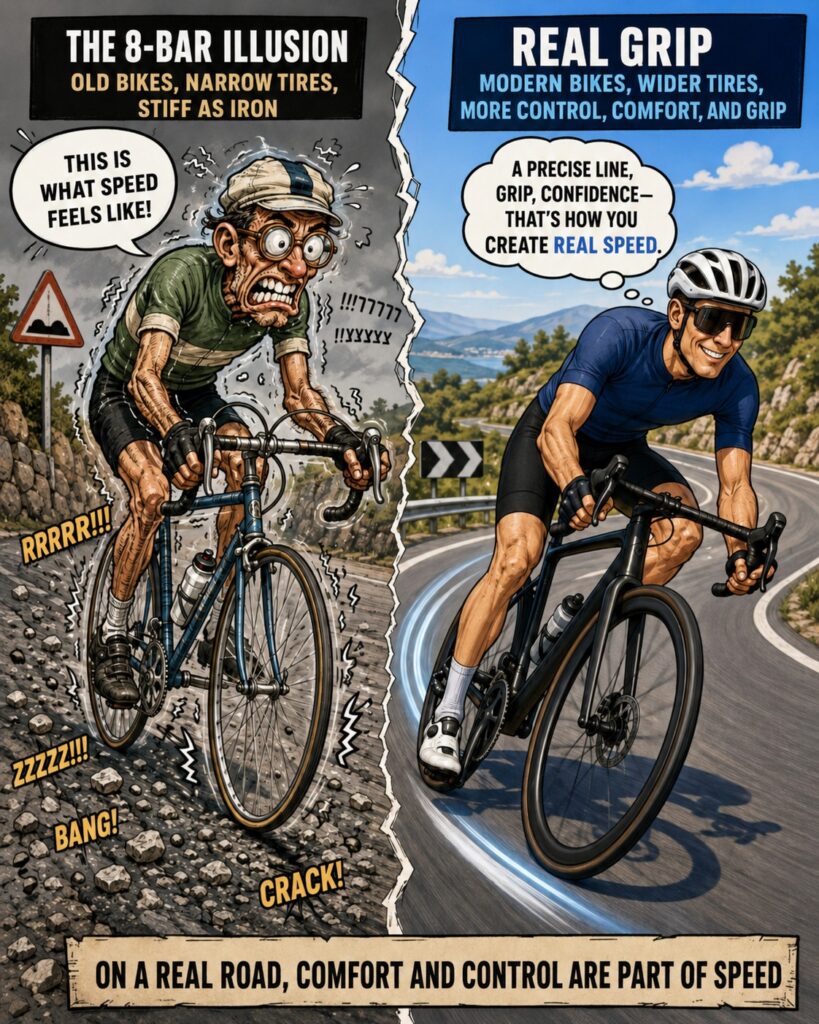
The Eight-Bar Illusion: Harsh Is Not Necessarily Fast
For years, a narrow, hard tyre at very high pressure felt fast because every stone reached the rider. On a perfectly smooth drum, high pressure can reduce some casing deformation. On a real road, excessive pressure makes the bicycle and rider move over irregularities instead of absorbing them. Energy disappears into vibration, vertical movement, lost grip and line corrections.
A wider tyre at pressure matched to rider mass, rim width and road surface can provide more grip, fewer vibration losses, a more stable contact patch, less accumulated fatigue and a better ability to hold position and produce power.
Rim and Tyre Became One System
Modern rims widened to support wider tyres and create a cleaner tyre–rim transition. They also became deeper and more aerodynamic. Yet a deeper wheel is not always a faster wheel.
A wheel may test brilliantly in a tunnel and become slower for a rider who cannot control it in crosswinds. If the rider stiffens, opens the body, stops pedalling on a descent or slows down, some theoretical saving disappears.
“What is the fastest wheel?” is meaningless without asking: for which rider, at what mass, in which wind, with which tyre and pressure, on which course?
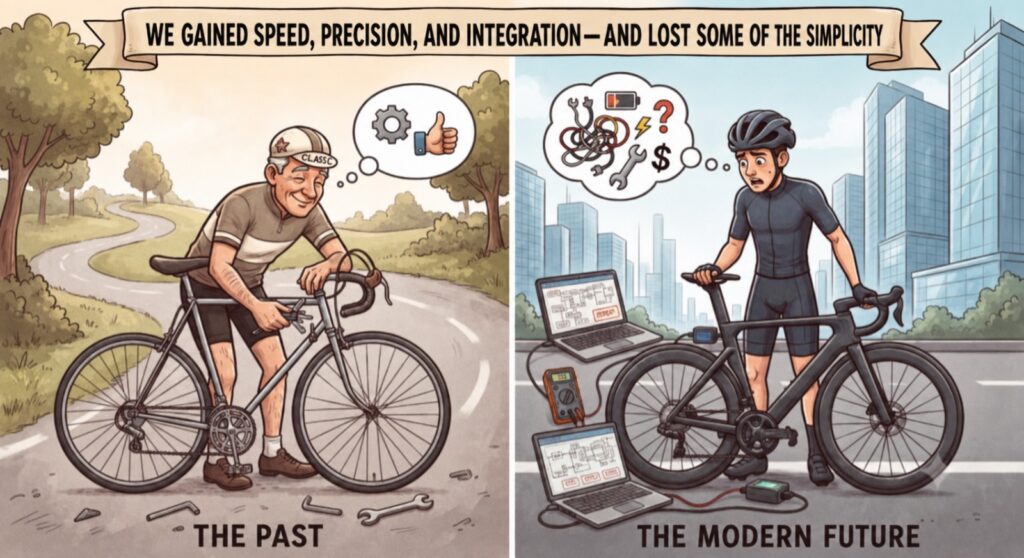
Cables Disappeared, Shifting Became Smarter — and Bikes Became Less Simple
Brake hoses vanished into bars, stems and frames. Electronic shifting became normal, and integrated cockpits reduced exposed hardware. The gains are a cleaner aerodynamic front, accurate shifting under load, additional shift-button locations and less disruption to airflow.
The price is complexity. A small bar-height change may require major work. Changing a stem can mean opening hydraulic lines. Proprietary parts are expensive and difficult to source. Simple field repairs become harder, and the rider becomes more dependent on manufacturer and mechanic.
The Power Meter Does Not Turn the Pedals, but It Changed Racing
A power meter creates no power. It changed training and pacing by giving the rider another layer of control: whether a climb began too hard, whether wind raised the cost, whether pace matches the plan and whether an energetic debt is becoming impossible to repay.
Data should not replace tactics or sensation. A rider staring at numbers instead of road, rivals and body can turn measurement into a cage. The best professional knows both when to use the number and when the race requires a different decision.
Modern Bikes Are Faster — but Not in Every Single Category
Better aerodynamics across wheels, frame, cables, clothing and helmet.
Less vibration, lower rolling losses and more grip.
Consistent braking, control and confidence.
Power, accurate shifting and timed fuelling integrated into one plan.
Modern bicycles do not win every isolated category. They are better at connecting categories.
What Is Actually Relevant to an Amateur?
Do not buy Pogačar’s bicycle. Understand which problem each component is attempting to solve.
- Tyre and pressure: suited to your total system mass, rim and actual roads?
- Position: can you breathe, control and produce power for long enough?
- Brakes: maintained, adjusted and used progressively?
- Wheels: appropriate for wind, route and handling skill?
- Maintenance: serviceable at a reasonable cost and timescale?
- Training: can your body hold the position and speed the equipment is designed to enable?
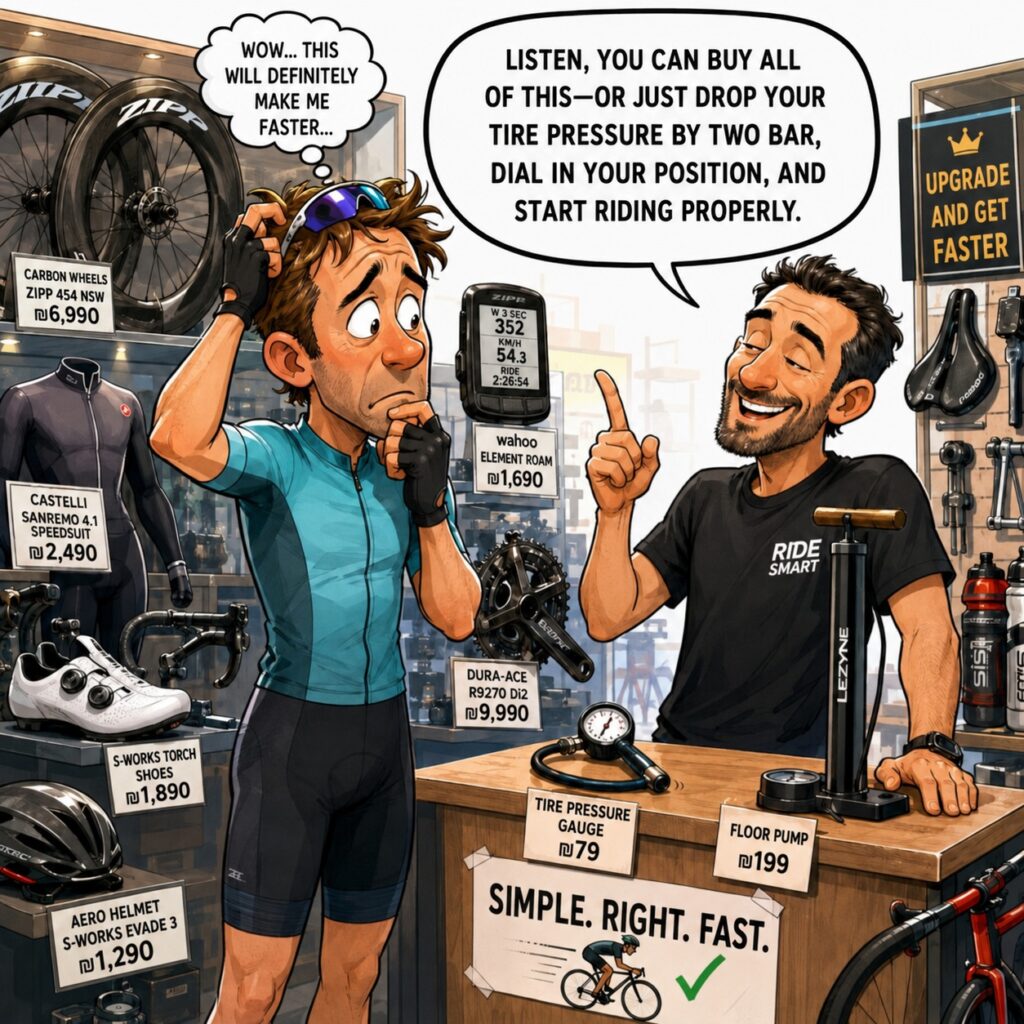
For many amateurs, appropriate pressure, a suitable tyre, a stable position and a clean drivetrain outperform a new frame as practical upgrades. Discs do not make a technically weak descender skilful. A deep wheel does not help a rider frightened by crosswind. Electronic shifting does not correct bad gear choice. An aero bike is not aero when its rider sits upright because the intended position is unsustainable.
We Do Not Need to Slow Pogačar Down
— We Need to Examine the Rules of the Game Part 6 – End
Concentrated power, competitive balance, and cautious ideas for reform.
UAE is not guilty of being strong, and Pogačar does not need to apologise for being exceptional. The question is what happens when success generates more money, money attracts more talent and talent generates more success.
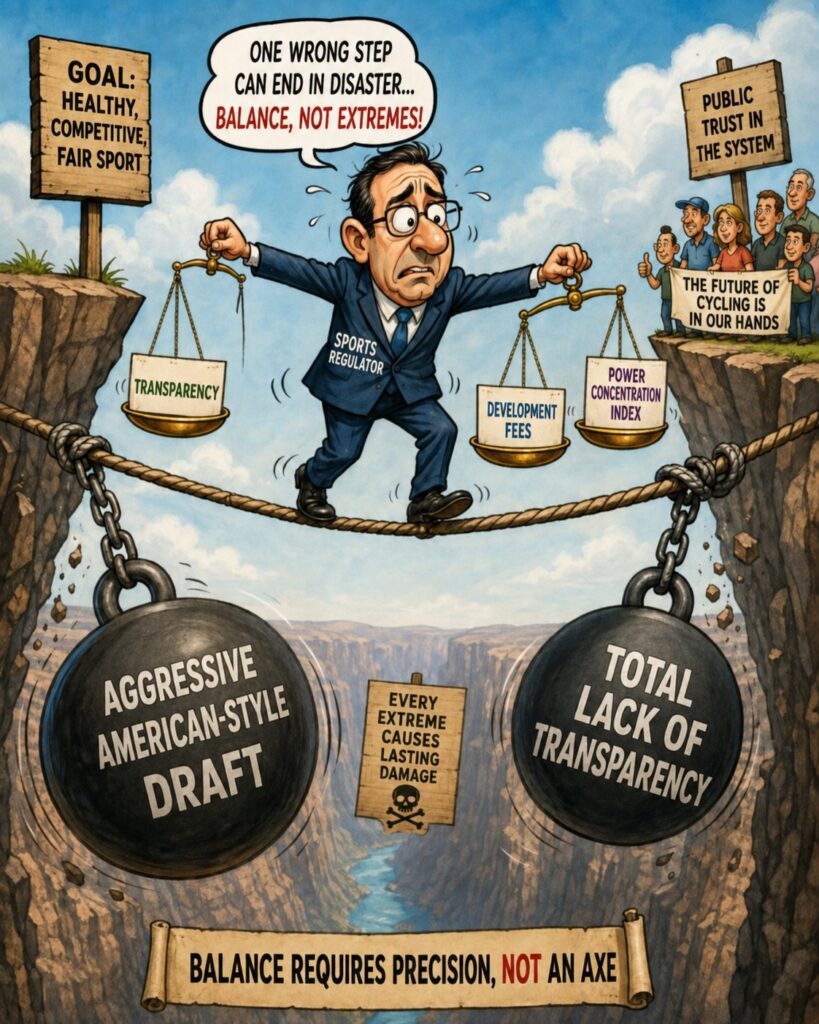
This is not a proposal for a compulsory draft or an instant salary cap. It begins somewhere less glamorous and more important: transparency, development compensation, protection for home-grown riders, a soft concentration index and simulation before sanctions.
UAE Is Not the Problem — It Is Proof That the System Works
UAE does exactly what an ambitious professional team should do. It recruits talent, develops young riders, signs leaders, builds a performance department, invests in science and equipment, and tries to win.
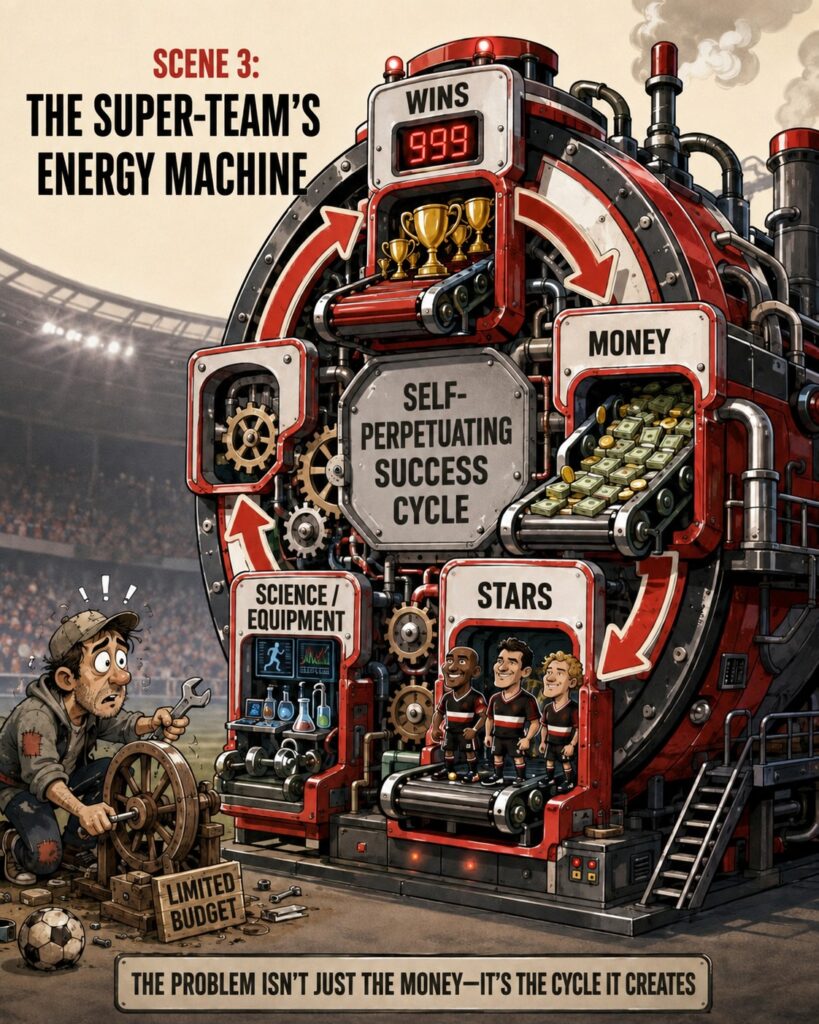
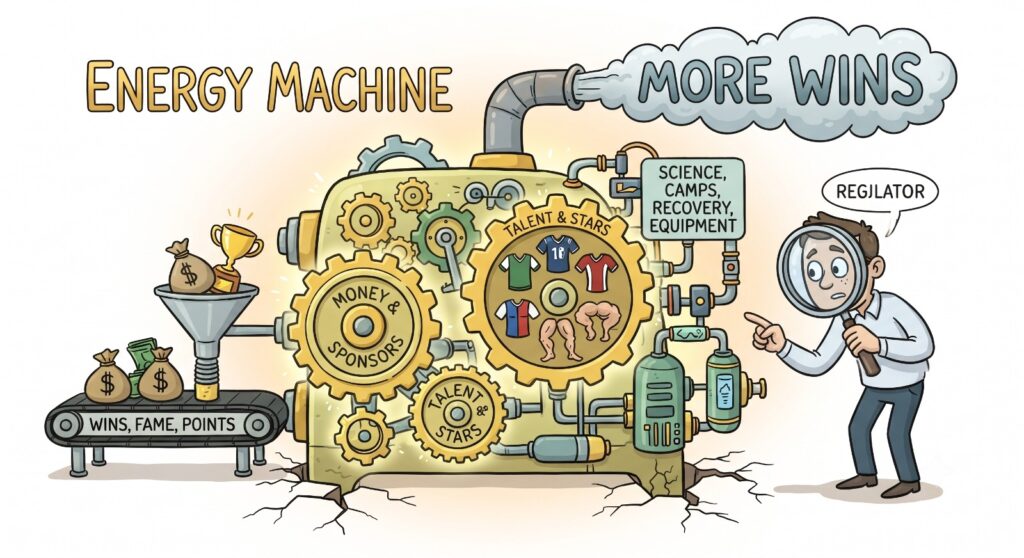
The potential problem begins when an advantage stops being a temporary reward for good management and becomes a self-feeding cycle:
create exposure, prestige and points.
attract sponsors and support longer contracts.
arrives: stars, leaders and development riders.
adds science, equipment, camps and recovery — creating more victories.
The gap is no longer merely preserved. It reproduces itself.
Success Should Not Be Punished
The goal is not to guarantee equal victories. Professional sport is not kindergarten, and the podium is not a participation prize. Nor should a team be punished because it made better decisions. A rule that restricts UAE while leaving mediocre management untouched does not repair competition.
What Can Cycling Learn from the NFL and NBA?
The useful lesson from American leagues is not the draft-night theatre. It is the recognition that competitive balance does not always create itself.
The NFL operates a hard team salary cap; for 2026 it was set at $301.2 million per club. Draft priority is broadly reverse-ordered by results, and compensatory mechanisms exist around free agency.
The NBA uses a softer cap, a luxury-tax line and progressively restrictive apron levels. Its draft lottery gives weaker teams earlier access to incoming talent while attempting to reduce the incentive to lose deliberately.
The principle is transferable: success should bring advantage, but a competition does not have to allow that advantage to become unlimited control.
Why the American Model Cannot Simply Be Copied
- Cycling has no single closed league controlling all races and revenue.
- Teams depend on different sponsors and often insecure contracts.
- Organisers, UCI, teams and riders are not one economic body.
- The sport crosses countries, labour law and tax systems.
- Budgets and salaries are not transparent enough to support a credible cap.
A compulsory draft could collide with freedom of employment. A cap without reliable accounts could become accounting theatre. A crude points ceiling could punish a team because several riders it developed improved together.
What Not to Do
- Do not assign riders to teams against their will.
- Do not cap salaries before credible transparency exists.
- Do not punish successful development.
- Do not build a system on one season or one ranking.
- Do not protect mediocre management in the name of parity.
What Could Be Tested Carefully?
1. Transparency before restriction
An independent body could collect audited, confidential data on budget bands, roster cost, development investment, transfers and concentration of ranking points. Not every number must be public, but regulation cannot be built on rumours.
2. Development compensation
A team or academy that invested in a young rider should receive compensation when a wealthier team signs him, without preventing the rider from choosing where to work.
3. Protection for home-grown riders
A rider developed inside the system should not be counted exactly like a proven star purchased as a finished product.
4. A soft concentration-of-power index
Begin with a diagnostic index using several seasons and adjustments for age, injury and home-grown status. Publish it without sanctions. Back-test it against history before attaching consequences.
5. A balancing levy only after reliable data
High-budget teams might eventually contribute to development, safety, minimum salaries and financially vulnerable teams. Without audited data, a “luxury tax” is only a handsome headline.
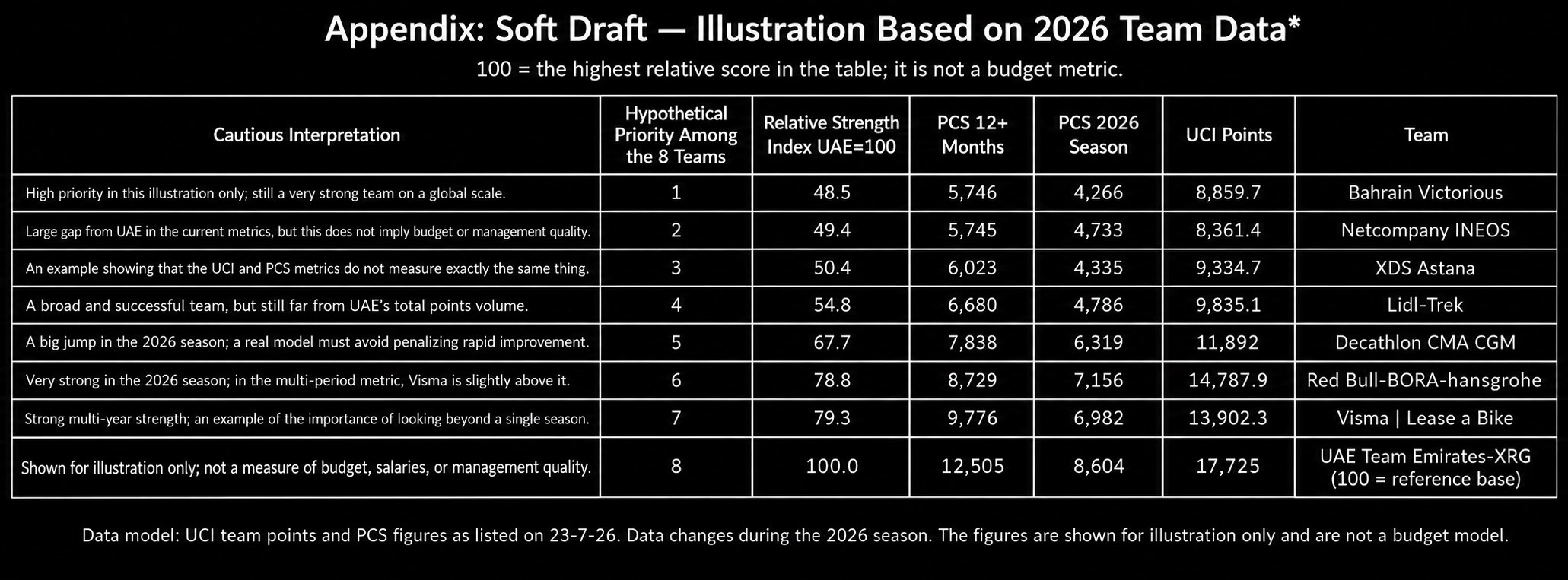
Pilot before Revolution
- Define one development-compensation mechanism.
- Create a credit for home-grown riders.
- Publish an annual concentration index without initial sanctions.
- Back-test previous seasons for distortions.
- Conduct legal and economic review with riders, teams and organisers.
Only after a model demonstrates that it measures the problem without creating a larger one should binding measures be considered.
The Final Answer: Not One Secret — an Entire System

Pogačar is not merely an exceptional talent. Nor is he merely the product of money, altitude camps, short cranks or fast bikes. He is the meeting point between an extraordinary rider and one of the strongest, richest and most precise systems built around a cyclist.
There is no need to ask him to be less good. No need to send the peloton back to rim brakes, 23 mm tyres and a steak before the climb. No need to punish UAE for doing its job better.
The sport should enable more teams to build a genuine process — and examine carefully how success can be prevented from becoming an almost unchallengeable concentration of power.
The bikes progressed. The riders progressed. The teams progressed. It is time for the structure of the sport to try to catch up.
Is Ozempic UAE’s New Sponsor?

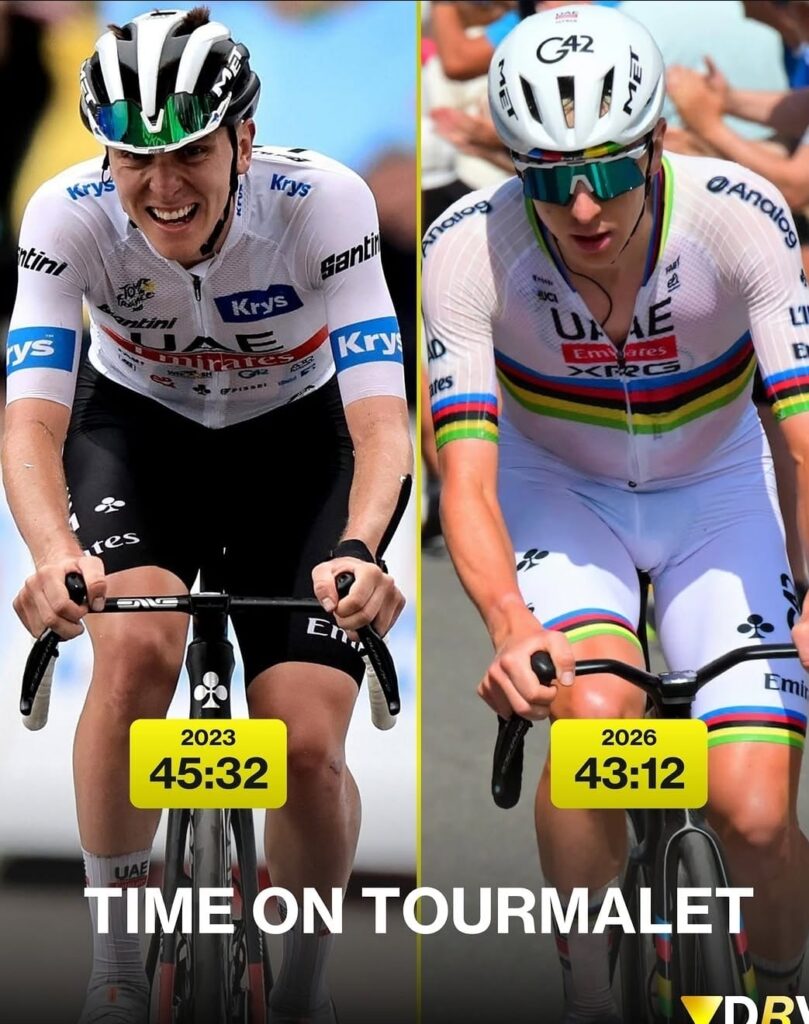
A wink at the simplest visible explanation — not an allegation.
At the opening of the 2026 Tour, Pogačar and Del Toro looked highly specific to the long climbs: sharp, efficient and able to sustain very high uphill speed. A social-media comparison of Pogačar on the Tourmalet in 2023 and 2026 made the visible contrast tempting to convert into a simple body-mass story.
But photographs cannot establish body mass or body composition. Camera angle, posture, clothing, lighting, hydration and processing all change appearance. Climbing times also combine race context, pacing, weather, tactics, drafting, equipment and fitness. The responsible conclusion is directional rather than numerical: the preparation looked more specifically optimised for sustained climbing.
Optimisation always involves trade-offs. A rider may accept a small change in absolute power or sprint behaviour in exchange for improved climbing economy and sustainable power-to-mass performance. In 2026, Pogačar often appeared to rely less on repeated accelerations and more on one acceleration followed by a brutally high sustained pace.
Across six parts we discussed money, roster depth, science, altitude, fuelling, watts, cranks, wheels, tyres and aerodynamics. All matter. But the simple reading should not disappear beneath them:
Sometimes that is most of the story.
Selected Sources and Methodological Notes
- UAE Team Emirates–XRG and Tour de France official histories and results.
- UCI team rankings, regulations and equipment rules.
- ProCyclingStats rider, team and seasonal statistics. Rankings change during the season.
- Peer-reviewed endurance literature on durability, altitude exposure, heat adaptation, crank length, cleat position, rolling resistance and vibration losses.
- WADA Prohibited List and UCI rules concerning xenon and repeated carbon-monoxide inhalation.
- NFL Football Operations — 2026 salary cap and free-agency mechanisms.
- NBA official explanations of the salary-cap system and Draft Lottery.
- Budget and salary figures in professional cycling are media estimates rather than audited public accounts.
- Historical climbing times are not controlled experiments: timing points, wind, road, race situation and data quality may differ.
- Regulatory proposals in this article are a thought experiment and pilot framework, not legal advice or an official UCI plan.
Power without Control = Waste
PowerWatts training does not promise to turn you into Pogačar. It teaches you to produce power, control it and remain effective when fatigue arrives.
Register for Two Trial Sessions
Who Is It For, and How Does It Work?